
Immune Monitoring for Vaccine Development Using Illumina SomaSeq Discovery
A novel high-throughput platform for sensitive and scalable immune profiling using the widest protein assay available.
Unbiased Immune Monitoring
Plasma proteomics can detect changes in a wide array of immune-related proteins — cytokines, chemokines, acute-phase proteins, and complement components — without prior assumptions. This helps identify novel biomarkers of vaccine efficacy and correlates of protection.
Current common strategies focus on single biomarker candidates in small cohorts, followed by classical immunoassays in much larger validation cohorts. Technique development offers new, more comprehensive strategies by plasma proteome profiling, in which the proteome patterns of large cohorts are correlated with vaccine administration.
Hickey et al is an interesting proof-of-concept study exploring the proteomic and serologic responses to mRNA COVID-19 vaccines, published in early 2025, utilising an aptamer-based proteomic assay targeting 7,289 plasma proteins. The study assessed responses at one and six months post-vaccination. A Random Forest analysis identified 85 baseline proteomic markers predictive of robust or weaker IgG responses at six months. The top contributors were associated with complement activation, IL-17 and TNFR signalling, PI3K pathways, and cell cycle progression — clearly demonstrating the utility of plasma proteomics for evaluating correlates and predictors of serological responses to vaccination.
The field of affinity proteomics is moving fast — especially the up-scaling using aptamer technology, which has superior multiplexing potential above antibodies. Illumina SomaSeq Discovery (SomaSeq) combines an innovative aptamer-based assay with NGS readout, delivering 9,000+ human protein targets in 200+ biological pathways, to maximise proteomics discovery power.
SomaSeq is in early access phase, already offered as a service via a few selected labs, including TATAA Biocenter.
SomaSeq Discovery Proteomics
- > 9,000 unique human protein targets
- 200+ biological pathways
- 10 log dynamic range
- Median CV of ~5%
- Fully automated workflow
- Overlay with transcriptomics for a multiomic approach
- Powered by SOMAmer® reagents
Why Immune Monitoring Matters in Vaccine Development
Monitoring the immune response to vaccination is essential for evaluating a vaccine’s effectiveness, safety, and long-term durability. In clinical trials, immune responses are assessed in human cohorts to determine whether the vaccine induces the desired immunogenicity and protection. These studies often include longitudinal sampling to monitor the development and persistence of immune responses over time.
Innate immunity is typically evaluated by measuring key cytokine levels such as IL-6, IFN-gamma, and TNF-alpha. Applying systems immunology approaches, including proteomics, offers a global view of immune activation — providing insights beyond traditional serological methods.
Other critical objectives include identifying correlates of protection-specific immune markers that predict real-world vaccine effectiveness, monitoring for vaccine safety signals, tracking the durability of immunity over time, and comparing immune responses across dosages and regimens to optimise vaccination protocols. Post-marketing surveillance then extends this work by tracking long-term immune memory, antibody and T/B cell response persistence, and identifying any changes that may indicate the need for additional booster doses.
“Advanced techniques such as proteomic profiling and clonal repertoire analysis of T and B cells are increasingly used to provide detailed insights into the immune landscape following vaccination.”
The Plasma Proteome
As described in Geyer et al, the proteins constituting the plasma proteome can be categorised into three classes:
- Functional plasma proteins — abundant proteins including HSA, apolipoproteins, acute phase proteins of the innate immune response, and coagulation proteins
- Tissue leakage proteins — enzymes such as ASAT and ALAT, and tissue-specific isoforms such as cardiac troponins
- Signal proteins — signalling molecules including hormones and cytokines, which have very low abundances at steady state. Baseline IL-6 levels are around 5 pg/ml, establishing a minimum 1010-fold dynamic range compared to HSA at ~50 mg/ml
SomaSeq addresses the challenge of this enormous dynamic range by separating samples into high, median, and low abundance plates, enabling a 10-log dynamic range with picomolar sensitivity.
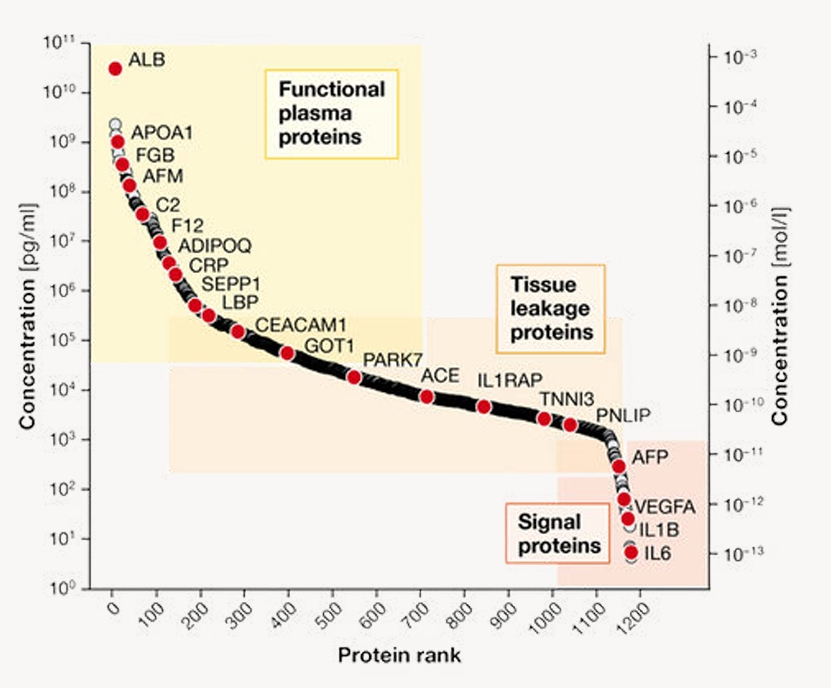
Figure 1. Concentration range of plasma proteins with the gene names of several illustrative blood proteins (red dots). From Geyer et al, Mol Syst Biol (2017).
The SomaSeq Advantage: The Broadest Panel Available
IPP offers the broadest available panel on the market. Combining the SomaLogic aptamer panel with NGS readout generates improved robustness as an end-to-end automated solution, with the potential to reduce noise especially in the lower detection range.
To contextualise the impact of using a wider panel, TATAA has identified the overlap between SomaSeq and other common high-throughput affinity proteomics platforms. Focusing on proteins included in the Gene Ontology (GO) Immune system process term and present in the Human Protein Atlas as expressed in blood, there is a theoretical overlap of 1,065 UniProt annotations. Shared immune system proteins account for 22% of the comparison; IPP covers 29% uniquely, compared to 5% uniquely covered by Olink.
When overlapping with FDA-approved human plasma biomarkers, there are 64 common annotations — SomaSeq captures 60 out of 64 (41% unique), compared to 5% unique for Olink.
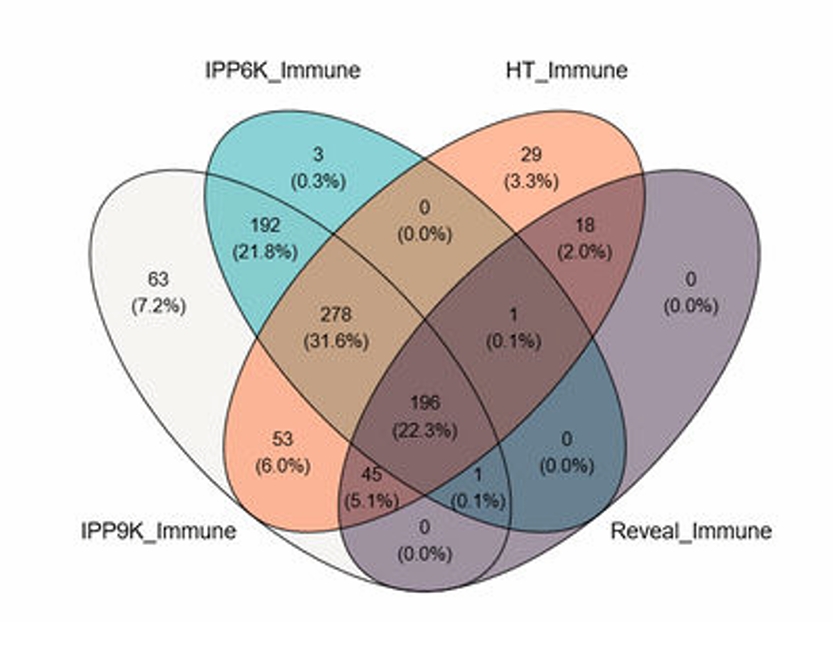
Figure 2A. Protein inclusion comparison across IPP 6K, IPP 9K, Olink Explore HT and Reveal — overlapping with GO Immune system process proteins present in the Human Protein Atlas (1,065 annotations).
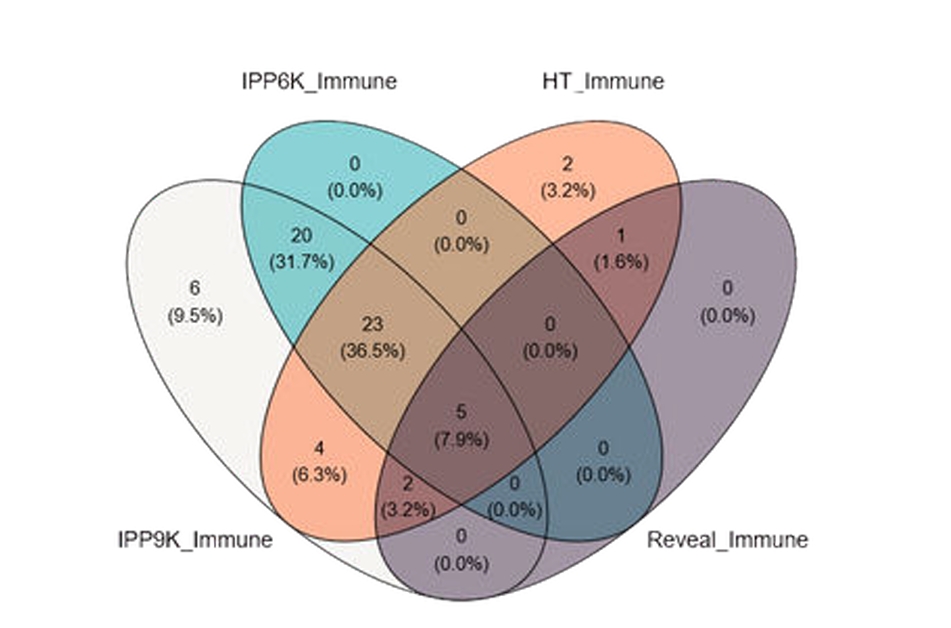
Figure 2B. Protein inclusion comparison across the same four panels — overlapping with FDA-approved human plasma biomarkers (64 annotations).
While SomaSeq enables ultra-high proteome coverage for broad discovery, Olink offers scalable, biologically curated panels with absolute quantification — exceptionally well suited for translational and clinical biomarker research. The two platforms are complementary: SomaSeq for discovery breadth, Olink for targeted precision.
Looking further ahead, the UK Biobank Pharma Proteomics Project (UKB-PPP) has selected the Olink platform to support the world’s largest human proteomics study, aiming to analyse more than 5,400 proteins from 600,000 samples. An overlapping 50,000 samples will also be run with SomaSeq at deCODE Genetics, funded by biopharma partners GSK, Johnson & Johnson, and Novartis — providing a key reference database for new target validation.
SomaSeq Workflow at TATAA Biocenter
The SomaSeq workflow at TATAA begins with receipt of plasma or serum samples — a minimum of 55 µL collected in EDTA tubes is required.

Sample preparation and randomisation: Samples are randomised based on groups for statistical analysis. If a project runs across more than one plate, groups should be equally distributed. Repeated measurements on the same sample should be analysed on the same plate to maximise statistical power.
Library preparation: Fully automated on a purpose-built Tecan robot. Ready libraries are loaded onto a NovaSeq 6000, where the S4 flowcell accommodates two plates of protein samples — up to 170 samples per run.
Secondary analysis: Performed in the Illumina Connected Analytics platform, handling demultiplexing and aptamer barcode counting. Raw protein counts are normalised using Hybridisation normalisation with twelve hybridisation controls, plus median normalisation and plate scaling using five calibrators. Outputs include an ADAT file (identical in structure to SomaLogic files), QC metrics, and a web-format QC report with PASS/FAIL results per sample or plate.
Tertiary analysis: Differential Protein Abundance (DPA) analysis identifies significantly up- or downregulated proteins between groups. Multi-omic layered analysis can be included where transcriptomic data is available from the same samples, using Partek for integration across omics layers.
References
1. Hickey TE et al. Proteomic and serologic assessments of responses to mRNA-1273 and BNT162b2 vaccines in human recipient sera. Front. Immunol., January 2025. doi:10.3389/fimmu.2024.1502458
2. Kirsher DY et al. The Current Landscape of Plasma Proteomics. bioRxiv 2025. doi:10.1101/2025.02.14.638375
3. Geyer PE, Holdt LM, Teupser D, Mann M. Revisiting biomarker discovery by plasma proteomics. Mol Syst Biol (2017) 13: 942. doi:10.15252/msb.20156297
4. Nanjappa V et al. Plasma Proteome Database: 2014 update. Nucleic Acids Res 42: D959-D965.
Run Your Vaccine Immune Monitoring Study at TATAA
TATAA Biocenter is one of a small number of early-access SomaSeq laboratories. Whether you are designing a vaccine immunogenicity study, exploring correlates of protection, or looking to add proteomic depth to an existing multi-omic programme, our team can help you design a study and interpret the results.
Request a quote → or contact our team to discuss your project.
