
Precision and Accuracy in qPCR and dPCR Assay Validation
Part 2 of the PCR Assay Validation Guide
In Part 1 of this guide, we discussed how assay validation begins with defining the context of use and understanding what decision the resulting data will support. The intended use of an assay determines what evidence is required to demonstrate that it is fit for purpose.
A qualitative assay may focus primarily on correctly identifying the presence or absence of a target, placing greater emphasis on sensitivity and specificity. Some exploratory biomarker assays may lack a true reference material, making absolute accuracy difficult to assess. In these situations, reproducibility, agreement with orthogonal methods, or other performance characteristics may be particularly important.
For quantitative qPCR and dPCR assays, however, some assessment of precision and accuracy is almost always required. The question is usually not whether they are needed, but how much evidence is needed based on the context of use. Whether measuring vector genomes in a gene therapy study, quantifying circulating biomarkers, assessing residual disease burden, or evaluating transgene expression, confidence in the reported result depends on answering two fundamental questions:
- If the same sample is measured repeatedly, do we obtain similar results?
- Are those results close to the true value?
These concepts are known as precision and accuracy. Together, they help determine whether apparent differences reflect genuine biology or simply analytical variation. Before sensitivity, linearity, robustness, or stability can be meaningfully interpreted, confidence must first be established in the reliability of the reported result.
Precision: How Consistent Are the Results?
Precision describes the agreement between repeated measurements of the same sample.
An assay with good precision produces similar results when the same sample is analysed repeatedly. Precision can be evaluated within a single run, across multiple runs, over several days, by different analysts, or on different instruments.
Precision is typically expressed as the coefficient of variation (%CV), where lower values indicate less variability across qPCR or dPCR replicates.
Accuracy: How Close Are You to the Truth?
Accuracy describes how close a measured result is to the true or expected value. For quantitative assays, accuracy is typically assessed using calibrators or quality control samples with known concentrations. Measured values are compared with the nominal concentration to determine the degree of bias.
Systematic bias may arise from calibration issues, matrix effects, extraction bias, pipetting errors, or other analytical factors.
Why Both Precision and Accuracy Matter
Precision and accuracy address different sources of analytical error. An assay can be:
- Precise and accurate — results cluster tightly around the true value
- Precise but inaccurate — results are consistent but systematically off
- Accurate on average but imprecise — results are scattered but centre on the true value
- Neither precise nor accurate — results are scattered and biased
Only the first scenario provides confidence that the reported concentration truly reflects the amount of analyte present in the sample.
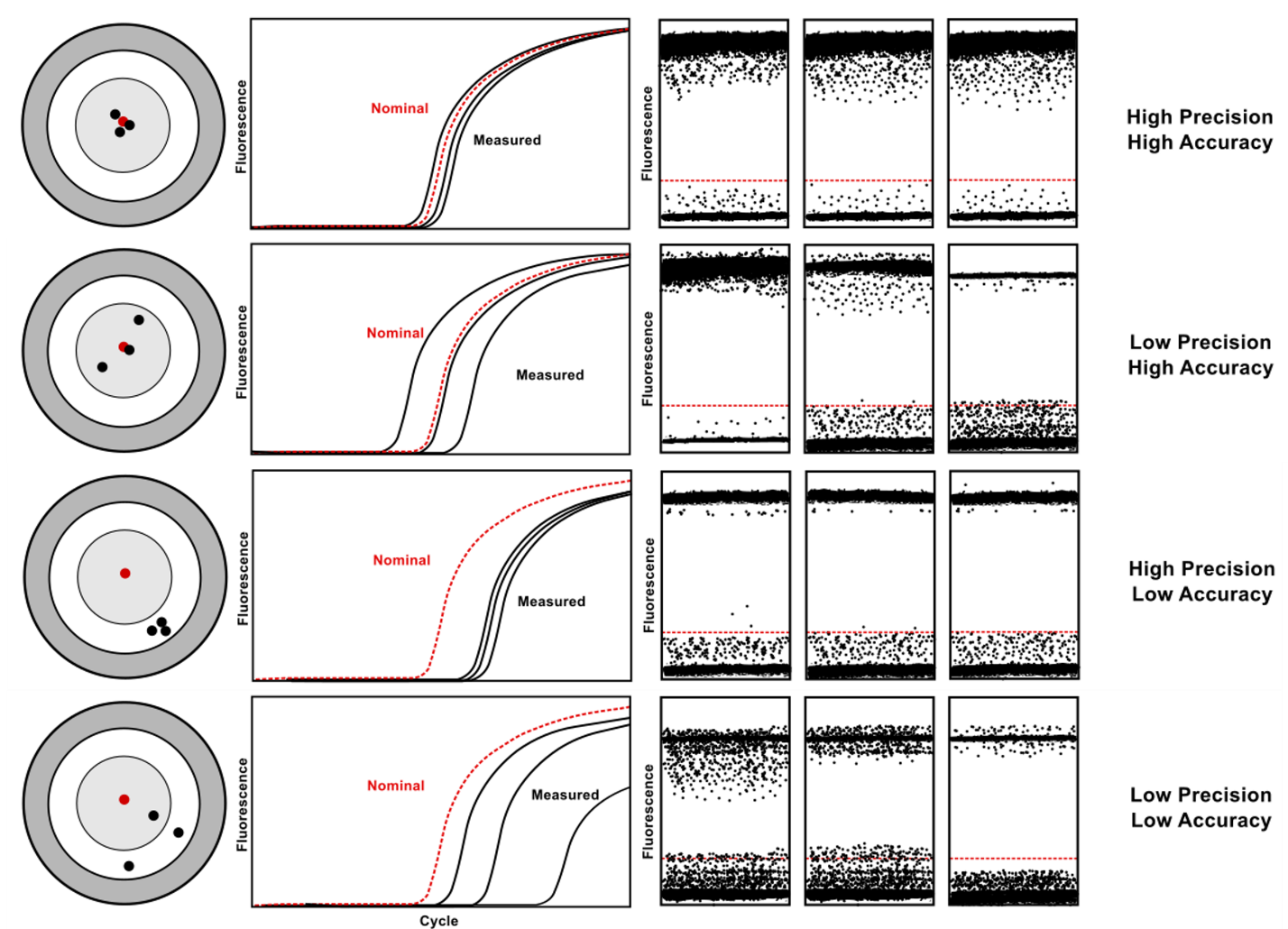
The four scenarios of precision and accuracy illustrated with bullseye targets and qPCR amplification curves (left) and dPCR partition plots (right).
How Precision and Accuracy Are Evaluated During Validation
During qualification and validation, precision and accuracy are typically assessed using quality control samples analysed repeatedly under defined conditions:
- Within-run precision (repeatability)
- Between-run precision
- Between-day precision
- Between-operator precision
- Between-instrument precision
- Accuracy across the assay range
- Accuracy at low, medium, and high QC levels
The number of replicates, QC levels, and acceptance criteria are defined based on the context of use — a fit-for-purpose qualification will require less extensive evidence than a full regulatory validation. What matters is that the evidence generated is sufficient to support the decision the data will be used to make.
Frequently Asked Questions
What is the difference between precision and accuracy?
Precision measures agreement between repeated measurements of the same sample; accuracy measures how close those measurements are to the true value.
How is precision measured in qPCR and dPCR?
Usually as the coefficient of variation (%CV) across replicate measurements taken within a run, between runs, and often between operators or instruments.
Can an assay be precise but still invalid?
Yes — if it consistently gives the same result but that result is off from the true value, it is precise but not accurate, and would fail validation.
Next in this series: Part 3 — Sensitivity and Specificity in Regulated Bioanalytical Assay Validation →
Need Support With Assay Validation?
TATAA Biocenter offers GLP- and GCLP-compliant method development and validation services for qPCR and dPCR assays, covering precision, accuracy, and the full suite of validation parameters from early feasibility through to regulatory submission packages.
Request a quote → or contact our team to discuss your assay needs.