
Linearity, Co-linearity, Robustness, Ruggedness and Stability in qPCR and dPCR Validation

Part 4 of the PCR Assay Validation Guide — The Final Chapter
This post concludes TATAA Biocenter’s PCR Assay Validation Guide. In Part 1 we introduced the principles of assay development, qualification and validation, and the importance of defining context of use. In Part 2 we discussed precision and accuracy, and in Part 3 we covered sensitivity and specificity.
Together, those parameters establish whether an assay measures the right target, with sufficient accuracy, precision and confidence. Validation must also demonstrate that assay performance remains reliable beyond ideal experimental conditions.
An assay may demonstrate acceptable performance under controlled conditions yet still fail to generate reliable data during routine use. Real study sample analysis often introduces variability in target concentration, sample handling, storage conditions, and operators.
This final chapter focuses on dilutional linearity, co-linearity, robustness, ruggedness and stability — the parameters that determine whether assay performance remains reliable under the conditions it could encounter during use.
Dilutional Linearity: Does the Assay Perform Across the Intended Range?
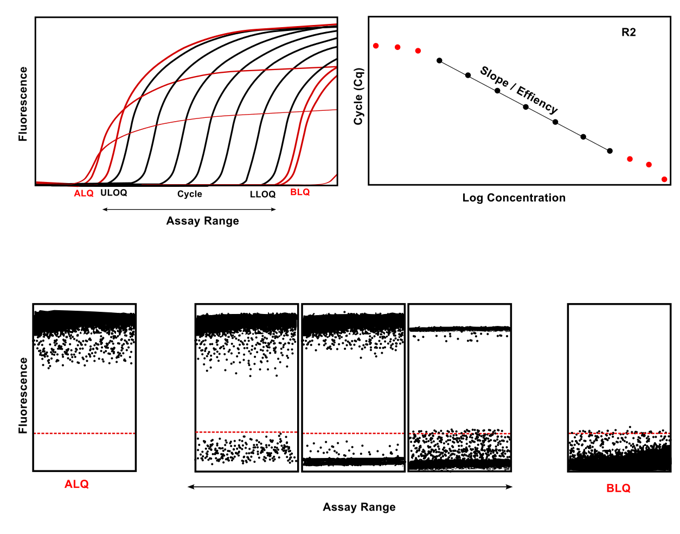
Dilutional linearity confirms whether assay response remains proportional when a concentrated sample is serially diluted. In practical terms, it evaluates whether a two-fold, ten-fold or other defined dilution produces the expected change in measured concentration. If the assay response remains proportional across the range, confidence increases that samples containing different target concentrations can be compared reliably. Dilutional linearity is often used to support establishment of the assay’s reportable range and provides evidence that samples may be diluted and still generate accurate quantitative results.
Results that fall within the validated quantitative range of the assay are considered quantifiable and can be reported with acceptable accuracy and precision:
- BLQ (Below the Limit of Quantification) — results falling below the LLOQ cannot be quantified reliably
- ALQ (Above the Limit of Quantification) — results exceeding the ULOQ fall outside the validated assay range and may require dilution and repeat analysis
Understanding where samples fall relative to the assay range is important when evaluating dilutional linearity and determining whether reported concentrations can be interpreted quantitatively. This is particularly important in cell and gene therapy studies, biodistribution work and biomarker programmes, where target concentrations may vary substantially between samples. Poor dilutional linearity may indicate matrix effects, inhibition, saturation or other assay limitations that compromise quantification.
Co-linearity: Does the Reference Material Behave Like the Real Samples?
Many bioanalytical assays depend on reference materials, calibrators or control materials to support assay development and validation. The challenge is that these materials do not always behave in the same way as actual study samples.
Co-linearity evaluates whether a reference material generates an analytical response that is comparable to the response observed in the intended sample matrix. A plasmid standard, synthetic oligonucleotide, gBlock, in vitro transcript or engineered control material may perform differently from the target molecule present in a clinical or preclinical sample. Differences in structure, extraction characteristics, fragmentation patterns or matrix interactions can influence assay performance.
Co-linearity testing provides evidence that the chosen reference material is a reasonable surrogate for the intended study samples. Without this evidence, quantification may be technically consistent while still failing to reflect biological reality.
Robustness: Can the Method Tolerate Small Changes?
No analytical method operates under absolutely identical conditions every time it is performed. Reagent lots change, pipetting volumes may vary slightly, thermal cyclers may exhibit minor differences and assays are often performed across weeks, months or even years.
Robustness evaluates whether small, deliberate variations in method parameters affect assay performance. Examples may include changes in:
- Reaction volume
- Reagent lots
- Annealing temperature
- Incubation time
The purpose is not to introduce large methodological differences, but to determine whether the assay remains reliable when subjected to the minor variations that inevitably occur during routine laboratory operation. A robust assay continues to meet predefined acceptance criteria despite these small changes.
Ruggedness: Is Performance Maintained Across Routine Laboratory Variability?
While robustness focuses on controlled method variations, ruggedness evaluates performance across the normal sources of variability encountered during routine use. This may include different:
- Analysts
- Instruments
- Reagent lots
- Days
- Laboratories
Precision and ruggedness are related but address different questions. Precision measures the variability of repeated measurements and is typically expressed as %CV. Ruggedness evaluates whether assay performance remains acceptable when routine sources of operational variability are introduced. While ruggedness experiments often include an assessment of precision, they additionally consider whether those changes affect overall assay performance, including accuracy, detection capability and agreement with predefined acceptance criteria.
Stability: Does the Analyte Remain Stable Under Intended Study Conditions?
The importance of stability becomes particularly clear in nucleic acid-based assays, where DNA and RNA can be affected by storage conditions, handling procedures and matrix-specific degradation mechanisms. The exact experiments depend on context of use and expected study conditions, though studies commonly evaluate:
- Freeze-thaw stability
- Bench-top stability
- Refrigerated stability
- Long-term frozen stability
The goal is simple: ensuring that measured results reflect the original state of the biological sample rather than degradation or other changes introduced during collection, handling, storage or processing.
As the final topic in this guide, stability provides a natural endpoint. The series began with context of use and the fundamental question of what evidence is needed to demonstrate that an assay is fit for purpose. It then progressed through precision and accuracy, and sensitivity and specificity — the parameters that establish whether the assay can generate reliable measurements.
Stability brings those concepts together by extending assay performance beyond the analytical measurement itself and into the practical realities of sample collection, handling, storage and processing.
Collectively, the validation parameters covered throughout this series provide the scientific and operational evidence needed to establish confidence in a bioanalytical method. From development and qualification through precision, accuracy, sensitivity, specificity, linearity, robustness, ruggedness and stability, each contributes to demonstrating that an assay is fit for its intended purpose and capable of generating reliable data to support scientific, clinical and regulatory decision-making.
Frequently Asked Questions
What is dilutional linearity in qPCR and dPCR validation?
Dilutional linearity evaluates whether assay response remains proportional when samples are serially diluted. It confirms that the assay performs consistently across the intended concentration range.
What is the difference between dilutional linearity and co-linearity?
Dilutional linearity assesses whether one sample behaves proportionally across a dilution series. Co-linearity evaluates whether a reference material behaves similarly to actual study samples.
What do BLQ and ALQ mean?
BLQ (Below the Limit of Quantification) refers to results that fall below the validated LLOQ and therefore cannot be quantified reliably. ALQ (Above the Limit of Quantification) refers to results that exceed the validated ULOQ and fall outside the assay’s validated quantitative range — such samples may require dilution and repeat analysis before quantitative interpretation.
Is co-linearity always required?
No. Co-linearity is typically evaluated when surrogate reference materials are used and there is a possibility they may behave differently from the intended study samples.
What is the difference between robustness and ruggedness?
Robustness evaluates the effect of small, deliberate method variations, while ruggedness evaluates reproducibility across different analysts, instruments, laboratories or days.
Why is ruggedness important in regulated bioanalysis?
Regulated studies often involve long timelines, multiple operators and repeated analytical runs. Ruggedness demonstrates that assay performance remains reliable under these real-world operating conditions.
What stability conditions are commonly tested?
Typical stability studies may include freeze-thaw stability, bench-top stability, refrigerated stability and long-term frozen storage stability, depending on context of use.
Why is stability testing important?
Without stability data, it may be impossible to determine whether a measured change reflects genuine biology or degradation occurring during sample handling and storage.
Need Support With Assay Validation?
TATAA Biocenter offers GLP- and GCLP-compliant method development and validation services for qPCR and dPCR assays, covering linearity, co-linearity, robustness, ruggedness, stability, and the full suite of validation parameters from early feasibility through to regulatory submission packages.
Request a quote → or contact our team to discuss your assay needs.