
GLP & GCLP Molecular Bioanalysis: Validating qPCR, dPCR and RNA-Seq for Preclinical and Clinical Studies
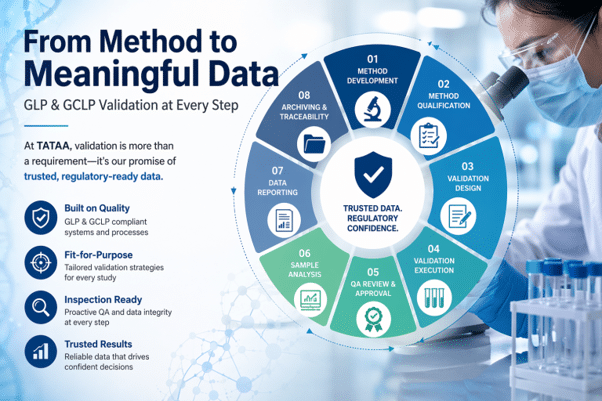
If you are choosing where to send your regulated molecular bioanalysis, the real question is not whether a laboratory can run a qPCR or dPCR assay – most can. It is whether the data those assays produce will stand up to a regulatory inspection months or years later. That difference comes down to how GLP and GCLP validation is designed and documented.
This is the work TATAA Biocenter has done since 2001: GLP- and GCLP-compliant molecular bioanalysis for pharmaceutical and biotech programmes across Europe and the USA, from preclinical safety studies through to clinical trial sample analysis.
GLP and GCLP: two frameworks, one continuous data trail
Good Laboratory Practice (GLP) and Good Clinical Laboratory Practice (GCLP) cover different stages of drug development, but they exist for the same reason – to make data accurate, traceable and defensible.
GLP governs non-clinical studies: the safety, biodistribution, viral shedding and pharmacokinetic data generated before a therapy reaches patients. GCLP governs the analysis of samples collected from human subjects during clinical trials. Both require structured quality systems, defined roles, full documentation and data integrity aligned with ALCOA+ principles.
The practical challenge in molecular and omics work is that a single method often crosses the boundary. A biomarker assay may be developed and validated under GLP, then applied to clinical samples under GCLP. When preclinical and clinical bioanalysis are split across different vendors, that transfer is where assays drift, terminology diverges and timelines slip. TATAA runs both frameworks under one integrated quality management system, so a method can carry through from preclinical to clinical without being rebuilt.
What “fit-for-purpose” validation actually means
Validation is often treated as a fixed checklist. In regulated bioanalysis it is a strategy: the depth of validation should match how the data will be used.
An exploratory biomarker readout and a pivotal primary endpoint do not need the same validation package. A sound validation plan is shaped by:
- Study phase – exploratory versus regulatory
- Sample type and matrix – and the interference that matrix introduces
- Analytical platform – qPCR, dPCR, RNA-Seq, DNA-Seq or proteomics
- Intended use of the data – what regulatory decision it supports
For PCR-based assays, validation typically covers specificity, linearity, limit of detection and quantification, precision and accuracy – and, for dPCR, partition-related performance. For RNA-Seq, it has to extend beyond the bench to the bioinformatics pipeline, because much of the variability in sequencing lives in library preparation and analysis rather than in the run itself.
Defining these parameters before analysis begins is what keeps a dataset usable. Validation decisions made early are the ones that determine whether a later submission goes smoothly.
Validation is necessary, but not sufficient
A validated method still fails an inspection if the system around it is weak. Inspection readiness rests on:
- SOP-driven workflows covering the full lifecycle, from sample receipt to final report
- Qualified instruments with traceable maintenance and calibration
- Documented training and demonstrated operator competency
- Data integrity controls aligned with ALCOA+
- Complete chain of custody and audit trails
These are the elements a GLP or GCLP auditor examines, and they apply equally on the non-clinical and clinical sides of a programme.
Why this is harder in advanced therapies
Cell and gene therapy, RNA therapeutics and other advanced modalities sit in a field with limited regulatory precedent, which means the validation requirements are often being defined as the science moves. TATAA works at that edge: our scientists are co-authors of the MIQE guidelines and contributors to AAPS recommendations on qPCR and dPCR method validation for cell and gene therapy (Hays et al., 2024).
That involvement matters when you are outsourcing: it means validation strategies are built with knowledge of where the regulatory thinking is heading, not only where it has been.
The business case for getting validation right
Strong GLP/GCLP validation is not only a compliance exercise – it is a way to de-risk a programme:
- Lower regulatory risk, because data is audit-ready by design
- Fewer delays, because submission-ready data does not have to be regenerated
- Lower rework cost, because robust methods hold up across the study
- Greater confidence in the decisions that data supports
In a competitive development environment, a CRO that builds validation into its process rather than bolting it on afterwards directly affects how fast and how safely a programme moves.
How TATAA approaches it
TATAA Biocenter is a GLP-accredited, GCLP-compliant and ISO/IEC 17025-compliant molecular CRO with 25 years of qPCR experience and hundreds of publications, including foundational bioanalysis guidelines. Across GLP and GCLP work:
- Methods are managed within a structured quality management system with defined method categories and full traceability
- Validation is built into project workflows from the outset, not retrofitted
- Advanced molecular expertise (qPCR, dPCR, Two-Tailed PCR, RNA-Seq, DNA-Seq and proteomics) is paired with dedicated QA oversight
- The same QMS spans preclinical and clinical phases, so methods transfer cleanly
The result is data that holds up in the lab, in audits and in regulatory submissions.
Planning preclinical or clinical molecular bioanalysis? Request a quote or talk to our team.
Frequently asked questions
What is the difference between GLP and GCLP in molecular bioanalysis?
GLP (Good Laboratory Practice) governs non-clinical studies – such as biodistribution, viral shedding and toxicology support – where data feeds regulatory safety assessments before a therapy reaches patients. GCLP (Good Clinical Laboratory Practice) governs the analysis of samples collected from human subjects during clinical trials. Both require documented quality systems, traceability and ALCOA+ data integrity, but they apply to different stages. A molecular assay such as qPCR or dPCR may be developed and validated under GLP for preclinical work, then transferred and applied under GCLP conditions when clinical samples arrive.
Can one CRO run both GLP and GCLP qPCR and dPCR studies?
Yes. A CRO with an integrated quality management system spanning both frameworks can carry a single molecular method from preclinical GLP studies through to clinical GCLP sample analysis without re-developing it. TATAA Biocenter operates as a GLP-accredited test site and runs GCLP-compliant clinical workflows under one QMS, which removes the handover gaps that occur when preclinical and clinical bioanalysis are split across different vendors.
Do qPCR and dPCR assays need full validation for clinical trial samples?
They need fit-for-purpose validation, and the depth scales with how the data will be used. An exploratory biomarker readout and a pivotal primary endpoint do not require the same validation package. Validation parameters typically include specificity, linearity, limit of detection and quantification, precision and accuracy, and for dPCR, partition-related performance. The validation plan should be defined against the study phase, sample matrix and intended regulatory use before analysis begins.
How is an RNA-Seq assay validated under GCLP?
RNA-Seq validation under GCLP focuses on showing that the full workflow – extraction, library preparation, sequencing and the bioinformatics pipeline – produces reliable, reproducible and traceable results for the intended measurement. That means locking down the analytical pipeline and reference parameters, demonstrating reproducibility across runs and operators, and documenting data integrity controls across both wet-lab and computational steps. Because much of RNA-Seq variability sits in library preparation and analysis, validation must cover the computational pipeline, not only the bench work.
When should I outsource GLP/GCLP molecular bioanalysis to a CRO?
Outsourcing makes sense when you need validated, inspection-ready molecular data but lack in-house regulated capacity, when timelines demand specialist platforms already running under GLP/GCLP, or when you want one partner to carry methods consistently from preclinical to clinical phases. Engaging a CRO early lets more validation decisions be aligned with downstream regulatory submissions.
What molecular technologies does TATAA Biocenter support under GLP and GCLP?
TATAA supports qPCR, digital PCR (dPCR), Two-Tailed PCR for short RNA, and RNA-Seq – applied to biodistribution, viral shedding, pharmacokinetics, pharmacodynamics, gene expression and biomarker studies.
