
Two-Tailed PCR: The Precision Tool RNA Medicine Has Been Waiting For

Why Short RNA Quantification Has Never Mattered More
The RNA therapeutics revolution is accelerating. The list of FDA-approved siRNA drugs has grown from zero to six in under a decade – spanning rare disease, metabolic, and cardiovascular indications – with dozens more in late-stage clinical development. Meanwhile, miRNA-based biomarkers are moving from discovery into clinical trial endpoints for oncology, cardiovascular disease, and neurodegeneration. And the newest frontier – CRISPR/Cas9 gene editing – adds a third short RNA modality to the bioanalytical challenge: single guide RNA (sgRNA) quantification in gene-edited cell therapies.
Behind every one of these programmes – from preclinical biodistribution to IND-enabling PK studies and clinical biomarker monitoring – sits a critical, often underappreciated question: how do you accurately measure a 20-23 nucleotide molecule in a complex biological matrix? Standard qPCR was designed for mRNA fragments hundreds of nucleotides long. It struggles fundamentally with molecules this short.
That is the problem TATAA Biocenter’s Two-Tailed RT-qPCR (2T RT-qPCR) platform was built to solve – and it does so with a combination of elegant chemistry, real-world validated performance data, and a regulatory-grade laboratory framework that few CROs can match.
The Core Analytical Challenge: Short RNAs Are Not Small mRNAs
miRNAs and siRNAs share an analytical headache that conventional qPCR approaches handle poorly: at 20-23 nucleotides, the target molecule is roughly the same length as a PCR primer. This creates compounding problems:
- Poor thermodynamic discrimination – a single nucleotide mismatch barely changes melting temperature at this length
- Family member cross-reactivity – miRNA family members often differ by just 1-2 nucleotides (e.g. miR-21-5p vs miR-21-3p, or siRNA guide vs passenger strand)
- Indirect detection strategies introduce bias – measuring the mRNA target transcript is a proxy, not a direct measure of the therapeutic molecule
- Extension methods reduce sensitivity – poly-A tailing and ligation approaches add noise and limit dynamic range
- Single hybridisation limits specificity – stem-loop approaches rely on one hybridisation event, which is thermodynamically insufficient for single-nucleotide discrimination
Each of the conventional alternatives – indirect mRNA detection, poly-A tailing, ligation, stem-loop RT-qPCR – addresses one of these problems while introducing others. What was needed was a chemistry designed from the ground up for short RNA targets.
The Two-Tailed PCR Principle: Cooperative Binding for Exceptional Specificity
The chemistry works through four sequential steps:
- Primer design – a hairpin primer is constructed with two target-specific hemiprobes: one hybridising to the 3′ end of the target, one to the 5′ end. These are connected by a stem-loop linker region.
- Cooperative binding and specificity – because both termini of the short RNA must match simultaneously, the cooperative binding energy enforces single-nucleotide resolution. A mismatch at either end destabilises the entire complex.
- Target elongation – reverse transcriptase elongates the target through the stem-loop, creating a cDNA compatible with standard PCR amplification.
- PCR bioanalysis – quantification proceeds with standard qPCR or dPCR using universal primers.
TATAA’s assay optimisation includes five different stem-loop region templates, variation in the length and position of 5′ and 3′ hemiprobes, and incorporation of LNA (locked nucleic acid) bases where needed to further tune specificity – particularly valuable when targets contain modified bases.
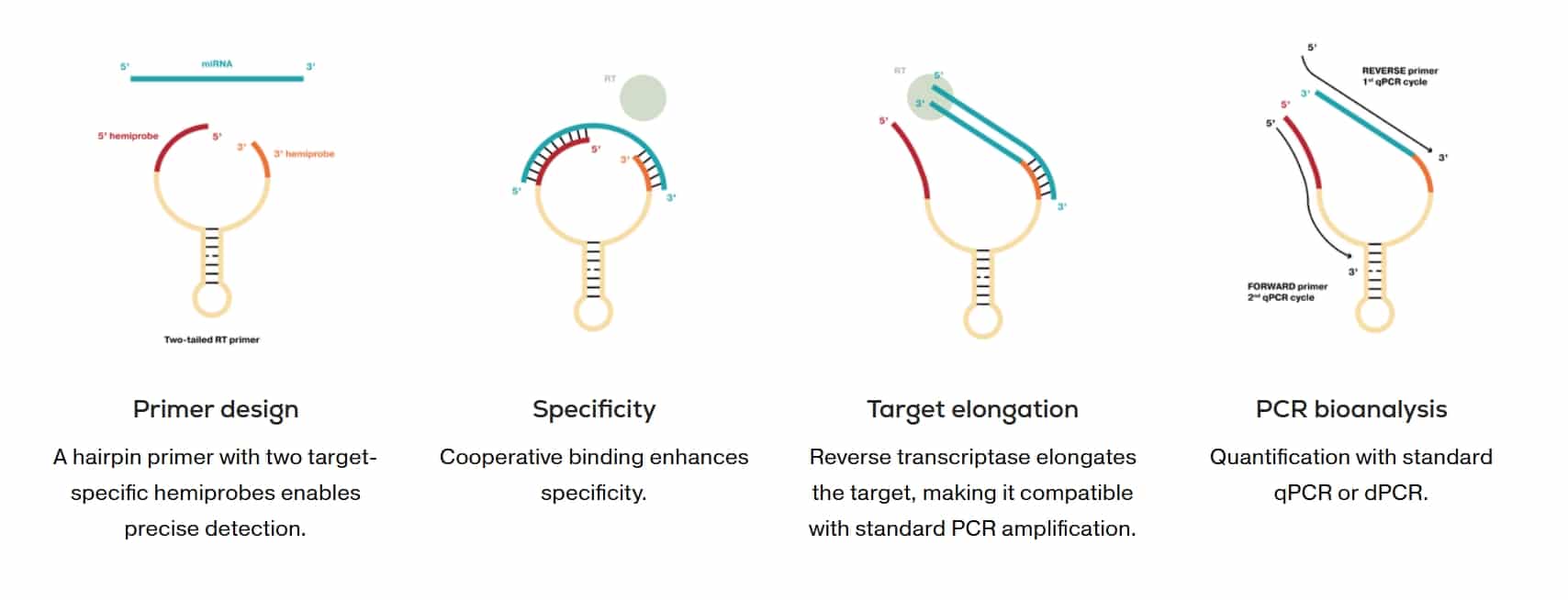
Figure 1. Two-Tailed PCR chemistry in four steps. The hairpin RT primer carries two target-specific hemiprobes that cooperatively lock onto both termini of the short RNA, enforcing single-nucleotide resolution. Reverse transcriptase elongates the complex into a standard PCR-amplifiable cDNA.
Real Performance Data: What the Numbers Show
Unlike many publications that demonstrate proof-of-concept in ideal conditions, TATAA’s 2T RT-qPCR platform has been validated across genuinely challenging scenarios. Here are five data sets drawn from their work:
Data Set 1 – Modified siRNA Detection
Six modified siRNA variants spanning two different chemical backbones and six modification patterns were each assayed. The results demonstrate that backbone modifications – including phosphorothioate linkages and 2′-O-methyl groups – have minimal impact on assay performance, even when placed over modified bases.
| Variant | Dynamic Range | Efficiency | R² |
|---|---|---|---|
| siRNA 1 | 2×10⁹ – 2×10⁵ | 84% | 0.997 |
| siRNA 2 | 2×10⁹ – 2×10⁴ | 82% | 0.998 |
| siRNA 3 | 2×10⁹ – 2×10³ | 82% | 0.998 |
| siRNA 4 | 2×10⁹ – 2×10⁴ | 90% | 0.998 |
| siRNA 5 | 2×10⁹ – 2×10⁴ | 83% | 0.998 |
| siRNA 6 | 2×10⁹ – 2×10³ | 84% | 0.996 |
All six variants: efficiency 80-110% ✓ | R² ≥ 0.995 ✓ | Two backbone types, six modification patterns
Data Set 2 – siRNA vs shRNA Discrimination
In cell-based gene therapy applications, unmodified siRNA is produced intracellularly from short hairpin RNA (shRNA) precursors – molecules that are partially identical in sequence but differ in secondary structure. The 2T RT-qPCR assay discriminates between siRNA and shRNA with an ~8 Cq separation, preferentially detecting the mature siRNA. This level of discrimination is critical for biodistribution and shedding studies in viral vector and cell therapy programmes.
Data Set 3 – Qualification in NHP and Mouse Brain RNA
For CNS-targeted RNA therapeutics, the ability to quantify siRNA in non-human primate (NHP) and rodent brain tissue is essential. TATAA has qualified 2T RT-qPCR assays in NHP brain RNA (with a standard curve spanning 8×10⁸ to 1.25×10⁴ copies) and demonstrated cross-qualification in mouse brain RNA with consistent quantification across multiple animals. This supports use of the platform for preclinical biodistribution studies in neuro-targeted programmes.
Data Set 4 – Direct Detection Without Extraction
Limited sample volumes are a pervasive challenge in clinical bioanalysis – particularly for paediatric studies, cerebrospinal fluid, and vitreous humour. TATAA has developed and optimised direct detection of siRNA in biofluids (50-100 µL for extraction; 5-10 µL for direct analysis). Measured recoveries were 95% for direct detection and nominally above 100% for the extraction approach – a common observation attributable to mild matrix effects in the reference samples. Direct detection, further optimised with stabilisers, eliminates extraction losses entirely and opens new options for programmes where sample volume is the limiting factor.
Data Set 5 – Single Guide RNA for CRISPR/Cas9
An emerging application: 2T RT-qPCR shows strong promise for detecting and quantifying single guide RNA (sgRNA) in the context of CRISPR/Cas9 gene editing therapies. As cell and gene therapy programmes require increasingly precise characterisation of editing components – including persistence, distribution, and off-target exposure – a validated, sensitive sgRNA quantification method addresses a genuine unmet need in the CGT bioanalysis toolkit.
The Broader TATAA Platform: Beyond 2T RT-qPCR Alone
Two-Tailed PCR is the centrepiece of TATAA’s short RNA offering, but it sits within a broader CGT bioanalysis and clinical biomarker platform that makes it particularly valuable for complex drug development programmes:
- Lentiviral detection for CAR-T – including a concept for integration site analysis (ISA), supporting the full CAR-T characterisation workflow
- GCLP RNAseq – clinical-grade transcriptomics for pharmacodynamic biomarker panels
- Immune repertoire monitoring – T-cell dynamics and broad immune activation profiling
- Proteomics – Olink proximity extension assay panels (including the Explore HT platform) and immunoprecipitation proteomics (IPP)
- Precious sample handling – TATAA’s 25 years of low-input extraction experience, with optimised PAXgene and similar protocols producing consistently higher RNA quality than manufacturer defaults
The laboratory infrastructure supports this: purpose-built PCR suites with temporal separation and positive air pressure, biosafety cabinets, automated liquid handling, Electronic Laboratory Notebook, and integrated LIMS with full sample traceability.
Why This Matters Now: The RNA Therapeutic Landscape in 2026
The siRNA pipeline is mainstream. Approved siRNA drugs now cover rare disease and cardiovascular medicine, with multiple late-stage programmes targeting cardiometabolic, CNS, and hepatic indications. Every IND submission for a siRNA drug requires validated bioanalytical methods for guide strand PK – and 2T RT-qPCR, with its strand selectivity and wide dynamic range, is increasingly the method of choice.
Modified backbones are the rule, not the exception. Essentially all approved and investigational siRNA therapeutics carry phosphorothioate and 2′-O-methyl modifications for metabolic stability. TATAA’s demonstration that 2T RT-qPCR performs consistently across six different modification patterns directly addresses the real-world bioanalytical challenge these programmes face.
CNS gene therapy is opening new frontiers. Programmes targeting Huntington’s disease, amyotrophic lateral sclerosis, and spinal muscular atrophy increasingly use siRNA components delivered intrathecally or by systemic dosing. Biodistribution studies in NHP brain tissue – as validated by TATAA’s Data Set 3 – are a regulatory requirement for these programmes, and few CROs have validated this capability.
miRNA biomarkers are entering the clinic. Companies developing miRNA mimics and anti-miR oligonucleotides need precision assays not just for their therapeutic molecules, but to track endogenous miRNA shifts as pharmacodynamic readouts. The single-nucleotide specificity of 2T RT-qPCR is essential here to avoid false signals from related family members.
Cell and gene therapy demands new bioanalytical tools. CRISPR/Cas9-based therapies require sgRNA biodistribution data – an application where 2T RT-qPCR’s emerging capability positions TATAA at the frontier of CGT bioanalysis.
Technical Comparison: How 2T RT-qPCR Stacks Up
| Feature | Indirect (mRNA proxy) | Poly-A / ligation | Stem-loop RT-qPCR | Two-Tailed RT-qPCR |
|---|---|---|---|---|
| Measures the therapeutic molecule directly | No | Yes | Yes | Yes |
| Single-nucleotide specificity | N/A | Poor | Moderate | Excellent |
| Guide/passenger strand discrimination | No | No | Limited | Yes |
| siRNA vs shRNA discrimination | No | No | Poor | Yes (~8 Cq) |
| Modified backbone compatibility | N/A | Poor | Poor | Good (validated) |
| Dynamic range (orders of magnitude) | 3-4 | 3-4 | 4-5 | 5-6 (up to 10⁹-10³) |
| Direct detection from biofluids | No | Limited | No | Yes (5-10 µL) |
| MIQE-compliant / GLP-ready | Possible | Limited | Yes | Yes (TATAA) |
| sgRNA / CRISPR applications | No | No | No | Emerging (validated) |
Method Validation: Fit for Regulatory Submission
TATAA validates 2T RT-qPCR assays to bioanalytical method qualification standards, covering all critical parameters required for IND, CTA, and BLA-supporting packages:
- Accuracy and precision (≤20% RE and ≤20% CV)
- PCR efficiency (80-110%)
- Dilutional linearity
- Sensitivity: LOB, LOD, and LLOQ
- Specificity and selectivity
- Robustness and ruggedness
- Stability
- Extraction efficiency and inhibition assessment
The laboratory operates under GLP, GCLP, and ISO 17025 frameworks with ALCOA+ data integrity principles, full audit trail, and experience across preclinical study reports, clinical biomarker reports, and regulatory submission packages.
Key Publications
Androvic, P., et al. Two-tailed RT-qPCR: A novel method for highly accurate miRNA quantification. Nucleic Acids Research, 2017, 45, e144. doi:10.1093/nar/gkx588
Androvic, P., et al. Two-tailed RT-qPCR panel for quality control of circulating microRNA studies. Scientific Reports, 2019, 9, 4255. doi:10.1038/s41598-019-40315-w
Vrbova, K., et al. Two-Tailed PCR for EV miRNA cargo characterisation. Molecular Therapy – Nucleic Acids, 2022. Demonstrating TT-PCR utility for extracellular vesicle miRNA profiling in limited sample volumes.
Getting Started
Whether your programme needs GLP-grade siRNA guide strand PK bioanalysis, circulating miRNA biomarker monitoring, direct detection from limited sample volumes, or sgRNA characterisation for a CRISPR therapy, TATAA’s 2T RT-qPCR platform offers a validated, regulatory-ready path to reliable data.
- Custom assay design and validation – target-specific 2T RT-qPCR assay development with full validation package
- Sample analysis – plasma, serum, tissue (including brain), cells, EVs, biofluids; extraction or direct detection
- Method transfer – validated protocols transferred to your in-house platform
- Regulatory documentation – GLP study reports, validation reports, IND/BLA-supporting packages
Learn more at tataa.com/technologies/short-rna-pcr/ or contact TATAA Biocenter at info@tataa.com.
Frequently Asked Questions
What sample types can 2T RT-qPCR be run on?
The platform has been validated across a wide range of matrices: plasma, serum, whole blood, cells, tissue (including brain), cerebrospinal fluid, vitreous humour, urine, and extracellular vesicles. For limited-volume biofluids, TATAA has optimised a direct detection workflow requiring as little as 5-10 µL – no extraction step needed.
How does 2T RT-qPCR handle chemically modified siRNA backbones?
Backbone modifications commonly used in therapeutic siRNAs – including phosphorothioate linkages and 2′-O-methyl groups – have minimal effect on assay design and performance. This was validated across six siRNA variants spanning two backbone types and six modification patterns, all meeting acceptance criteria (efficiency 80-110%, R² ≥ 0.995).
Can the assay distinguish the guide strand from the passenger strand?
Yes. Because both hemiprobes are strand-specific, guide and passenger strands can be independently quantified from the same sample, enabling pharmacokinetic studies that separately track each strand’s tissue distribution and clearance.
Is 2T RT-qPCR GLP-compliant?
TATAA Biocenter operates under GLP, GCLP, and ISO 17025 frameworks. Assays are validated to bioanalytical method qualification standards (accuracy/precision ≤20% RE/CV, LOD, LLOQ, selectivity, stability, and extraction efficiency), and study reports are formatted for inclusion in IND, CTA, and BLA submissions.
How long does assay development and validation take?
A typical new assay design, optimisation, and qualification can be completed in four to eight weeks depending on target complexity and matrix requirements. Full GLP validation runs eight to twelve weeks. TATAA has completed five full assay validations for a single programme in six months, so timelines can be compressed when development runs in parallel.
Can the platform be used for miRNA biomarker studies, not just therapeutics?
Absolutely. The same platform is routinely applied to circulating miRNA quantification for academic and clinical biomarker programmes – measuring miR-21, miR-155, miR-210, and other oncology-relevant targets in plasma or serum. The single-nucleotide specificity of 2T RT-qPCR is particularly important here, as many candidate biomarker miRNAs have near-identical family members that would generate false positives with less specific methods.
What is the key difference versus stem-loop RT-qPCR?
Both methods generate a cDNA that can be amplified by standard PCR. The difference is in the reverse transcription step: stem-loop RT-qPCR hybridises to only the 3′ end of the target – one hybridisation event. Two-Tailed RT-qPCR simultaneously locks onto both the 3′ and 5′ ends, requiring both termini to match for efficient elongation. This cooperative binding doubles the discrimination energy, enabling single-nucleotide resolution that stem-loop cannot reliably achieve, particularly for modified sequences.
Is the method published in peer-reviewed literature?
Yes. The foundational method was published by Androvic et al. in Nucleic Acids Research (2017, 45, e144), with a follow-up quality-control panel paper in Scientific Reports (2019, 9, 4255). TATAA Biocenter has built a comprehensive commercial service platform around the technology.